Fault-tolerance by construction
Aleks Kissinger + Oxford CS Quantum Group
Oxford QEC Workshop 2026

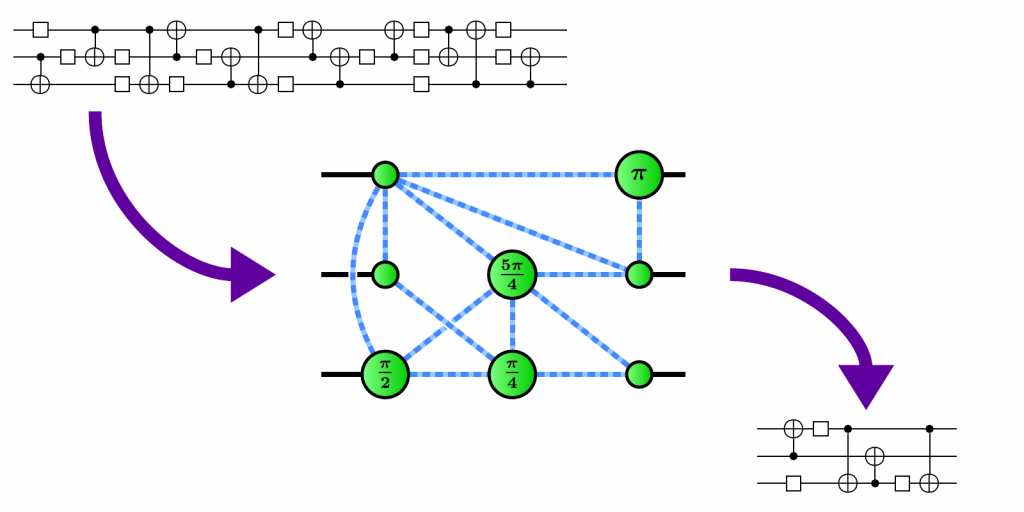
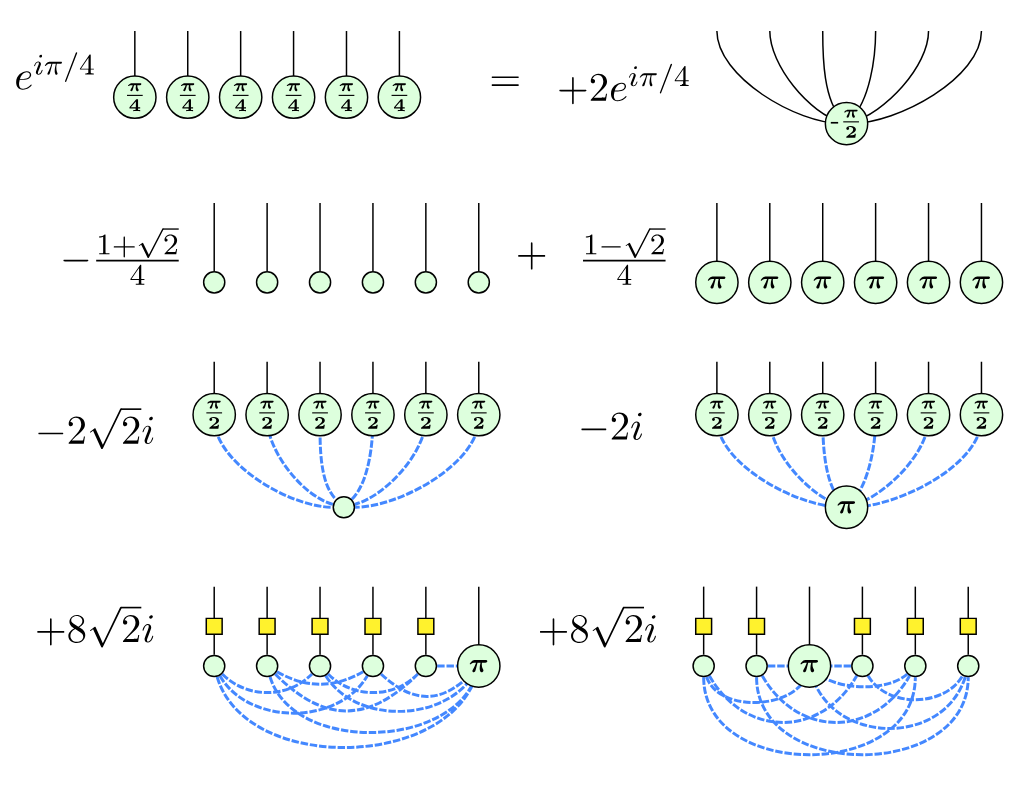
ZX-calculus
ZX := a handy tool for working with quantum
computations using graph rewriting
 |
 |
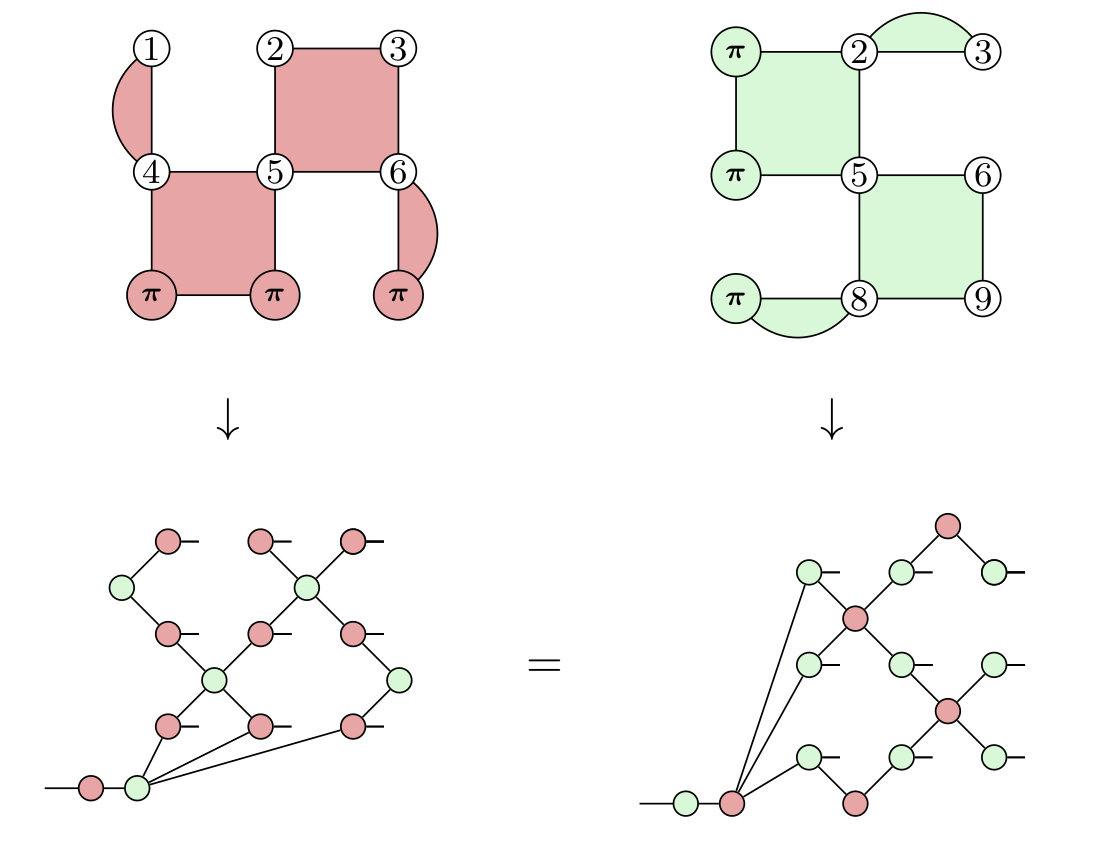 |
| Optimisation | Simulation & Verification | Error Correction |
ZX diagrams
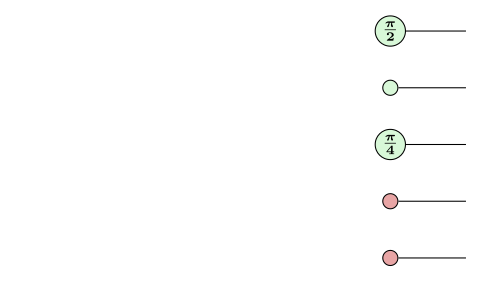
- Using basic building blocks, called spiders...
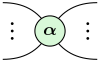
$:=$ $\ \ |0...0\rangle\langle 0...0| + e^{i \alpha} |1...1\rangle\langle 1...1|$ 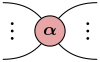
$:=$ $\ \ |{+}...{+}\rangle\langle {+}...{+}| + e^{i \alpha} |{-}...{-}\rangle\langle {-}...{-}|$
ZX diagrams
- ...we can build many gates:
$CNOT =$
 $CZ =$
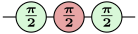
  $H =$
$H =$  $:=$
$:=$ 
$R_Z[\alpha] =$
 $R_X[\alpha] =$
- ...and measurements:
$\Pi_{Z...Z}^{(k)} =$
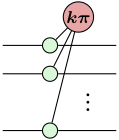 $\Pi_{X...X}^{(k)} =$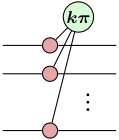
...then use the ZX calculus
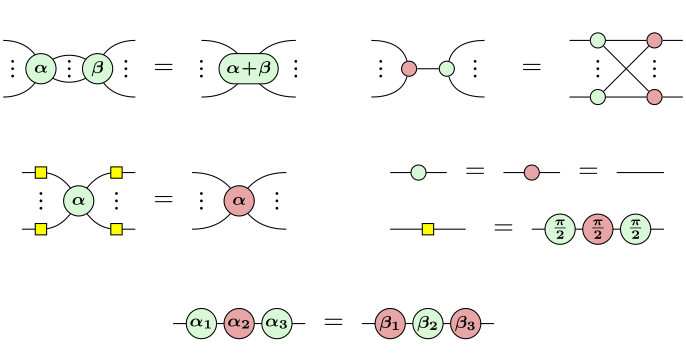
A complete set of equations for qubit QC
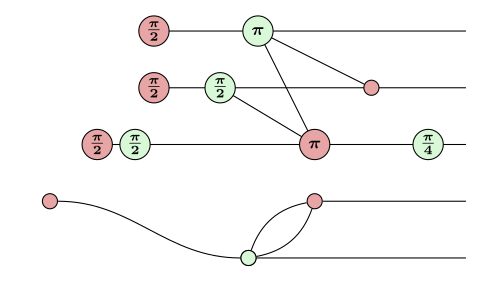
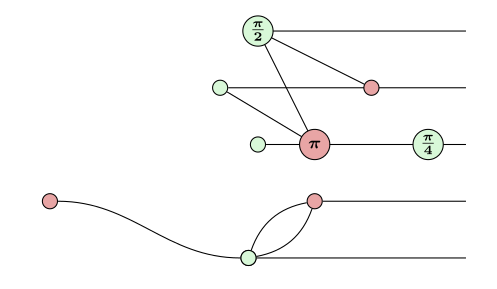
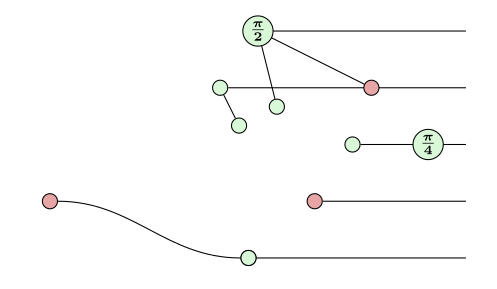
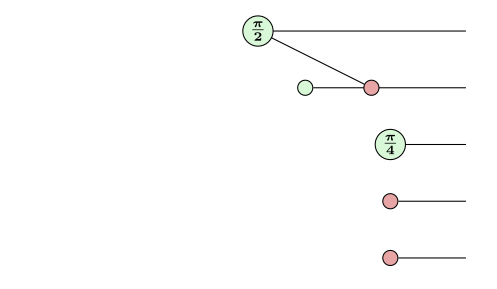
Clifford ZX calculus
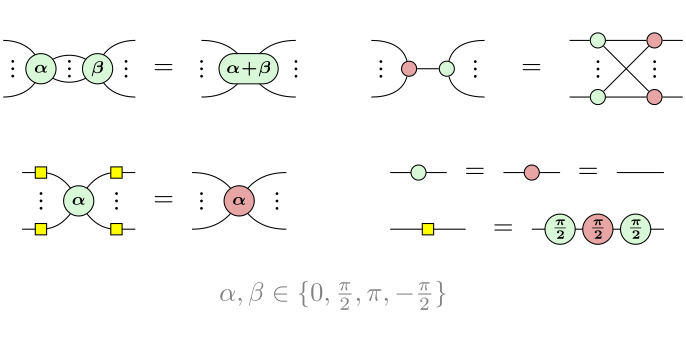
A complete set of equations for qubit Clifford QC
efficient synthesis, equality checking, classical simulation, ...
$\approx$ "graphical stabiliser theory"
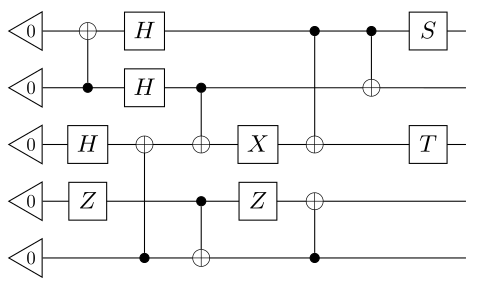
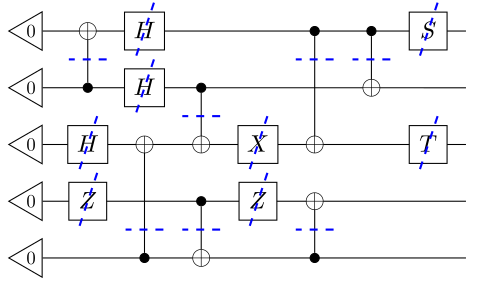
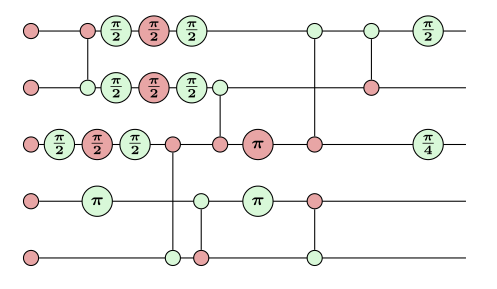
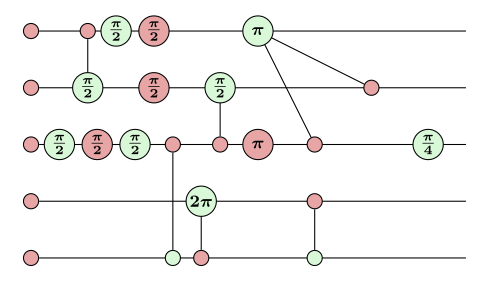
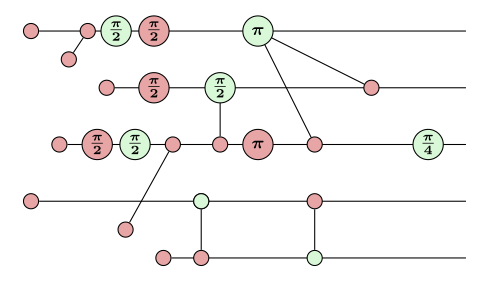
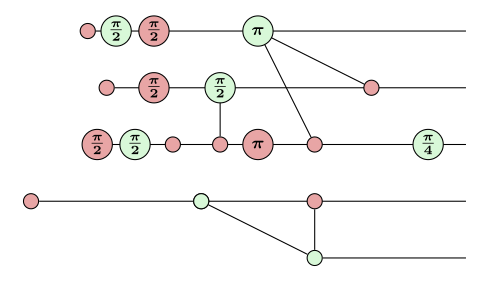
Quantum error correction
into a bigger space of physical qubits:
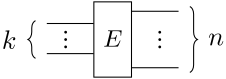
- $E$ (or just $\textrm{Im}(E)$) defines a quantum error correcting code
- Fault-tolerant quantum computing (FTQC) requires methods for:
- encoding/decoding logical states and measurements
- measuring physical qubits to detect/correct errors
- doing fault-tolerant computations on encoded qubits
Example: GHZ code
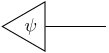 $\leadsto$

Example: GHZ code

Example: GHZ code

giving an error syndrome.
Graphical encoders
...give us a simple dictionary between QEC codes and ZX-diagrams, e.g. the GHZ code can be fully represented as:

Example: Steane code
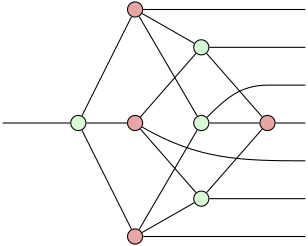
Example: Surface code
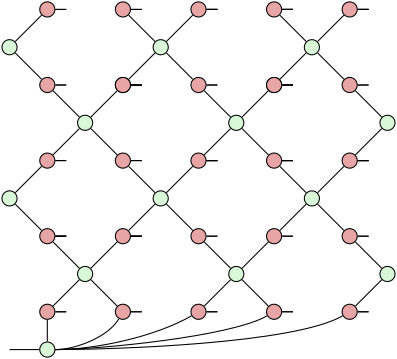
Example: [[8, 3, 2]] Colour code
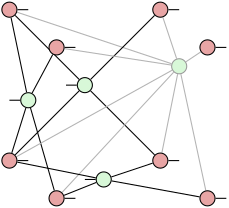
Fault-tolerant computation
But codes are only half the story in FTQC. We also need to know how to implement operations fault-tolerantly.
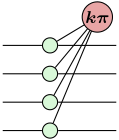
How can we implement this?
Example: measurement circuits
ZX can give us an answer:
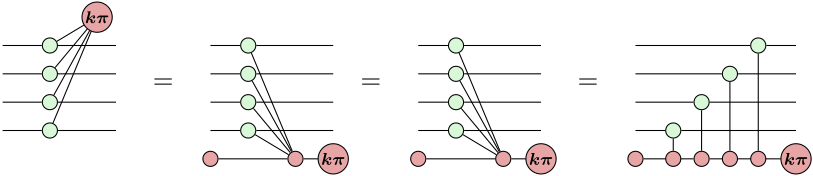
Q: Is the LHS really equivalent to the RHS?
A: It depends on what "equivalent" means.
Example: measurement circuits
They both give the same linear map, i.e. the behave the same in the absence of errors.

But they behave differently in the presence of errors, e.g.

Solution: Fault equivalence
What we need is a notion of equivalence that captures the behaviour of circuits (or ZX-diagrams) in the presence of errors, fault-equivalence:
$D \ \hat{=}\ E$
$D\ \hat{=}\ E \implies D = E$
$D = E \ \ \not\!\!\!\implies D\ \hat{=}\ E$
Fault-equivalence
Definition: Two circuits (or ZX-diagrams) $C, D$ are called fault-equivalent:
$C \ \hat{=}\ D$
if for any undetectable fault $F$ of weight $w$ on $C$, there exists an undetectable fault $F'$ of weight $\leq w$ on $D$ such that $C[F] = D[F']$(and vice-versa).
Fault-equivalence
- While all the ZX rules preserve map-equivalence, only some rules preserve fault-equivalence.
- It turns out the ones that do, e.g.
...are very useful for compiling fault-tolerant circuits!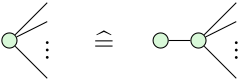
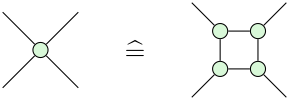
Paradigm: Fault-tolerance by construction
Idea: start with an idealised computation (i.e. specification) and refine it with fault-equivalent rewrites until it is implementable on hardware.

Specification/refinement has been used in formal methods for classical software dev since the 1970s. Why not for FTQC?
Example: Cat state preparation
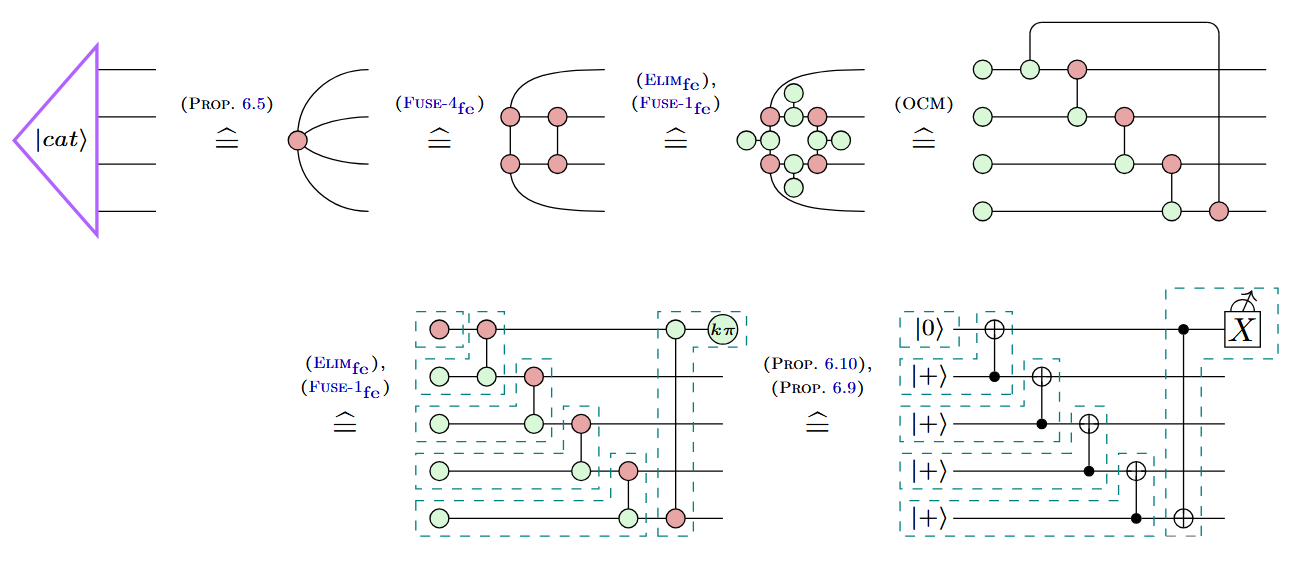
Example: Cat state preparation
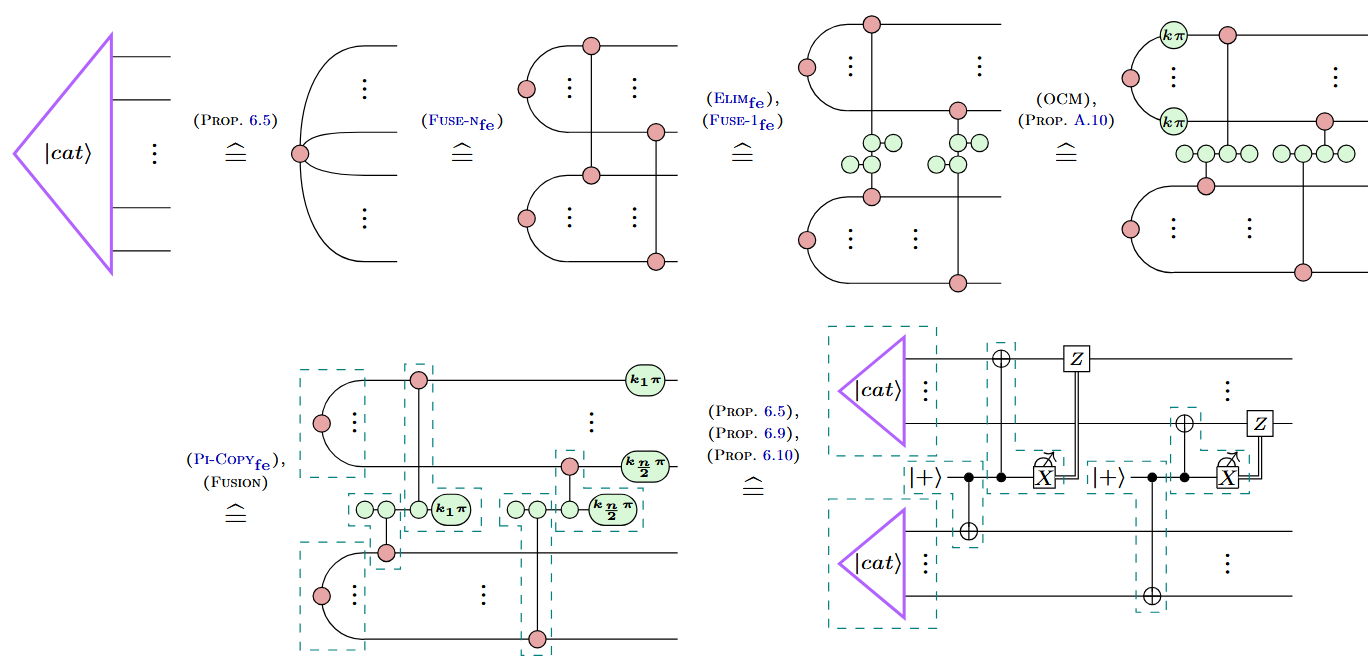
Example: Shor-style syndrome extraction
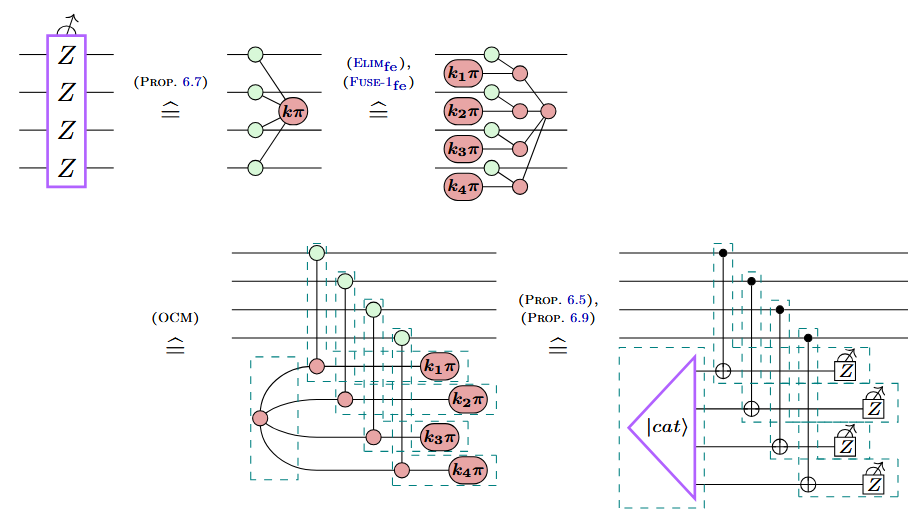
Example: A new variation on Shor
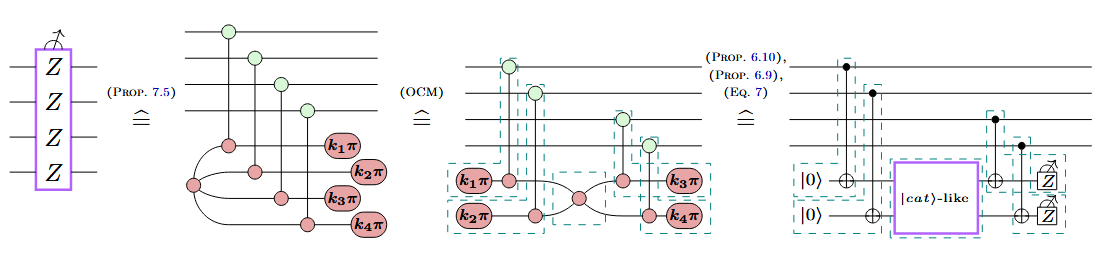
Example: Steane-style syndrome extraction
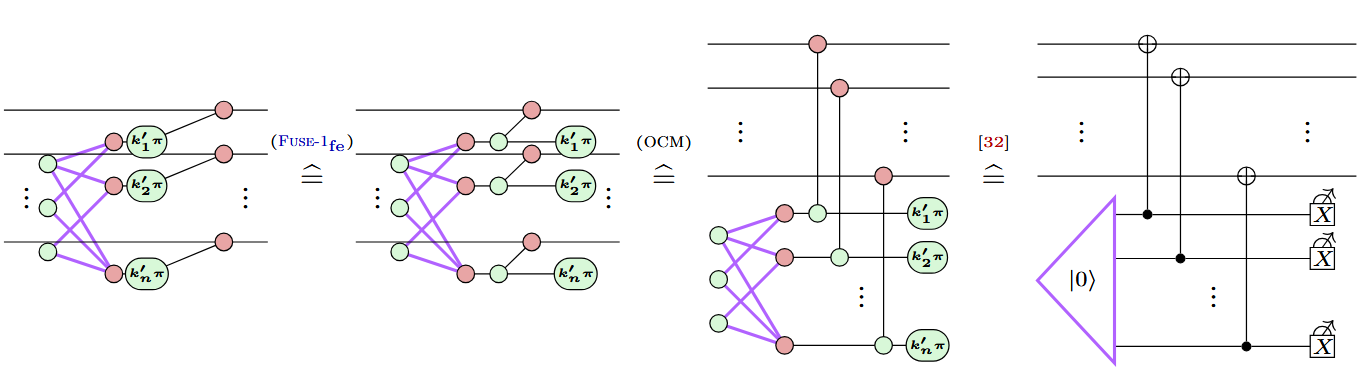
Example: A new variation on Steane (the same trick)
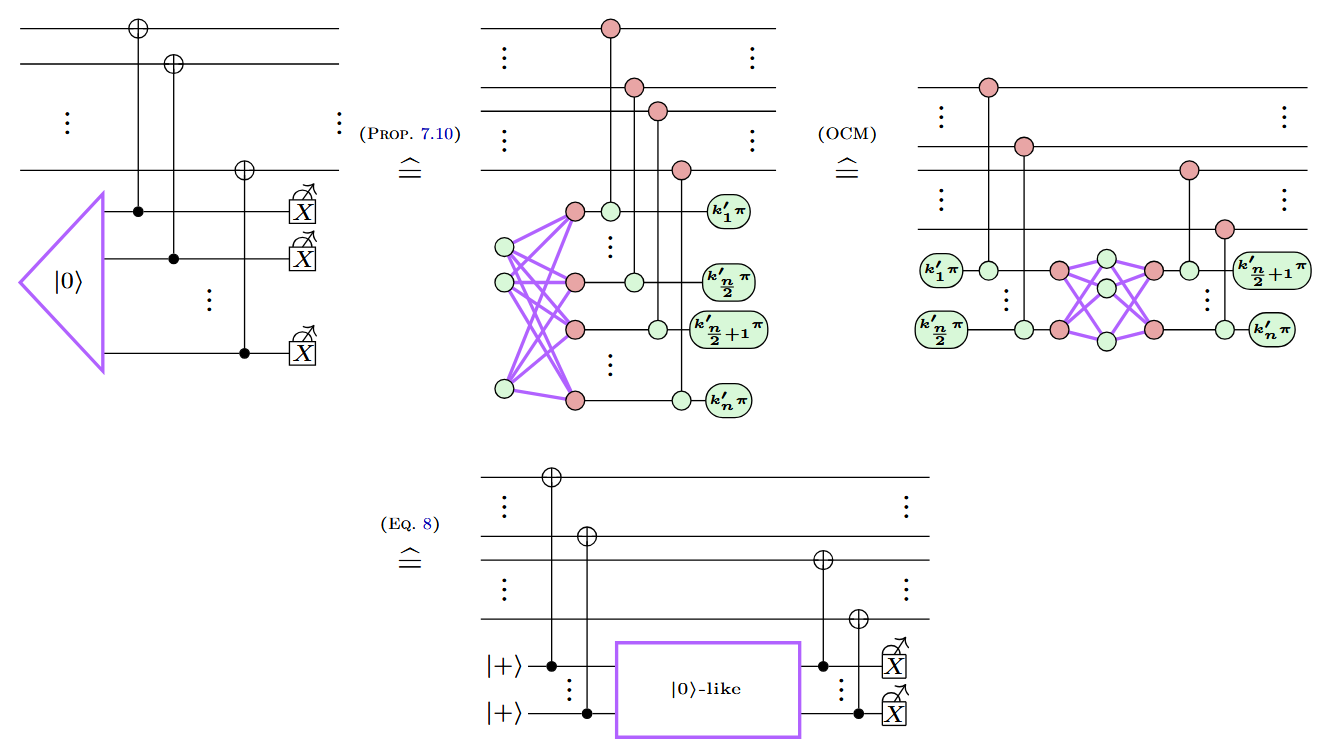
...with fewer qubits and a lower logical error rate!
Thanks!
Fault Tolerance by Construction » arXiv:2506.17181

https://zxcalc.github.io/book
(free book! Ch 12 = ZX + QEC)
https://zxcalculus.com
(350+ ZX papers, ~10% tagged QEC, online seminars, Discord)