ZX-Flow: A Flexible Criterion for Deterministic Computation with ZX-Diagrams
Aleks Kissinger and John van de Wetering
QPL, Amsterdam 2026

ZX-calculus
ZX := a handy tool for working with quantum
computations using graph rewriting
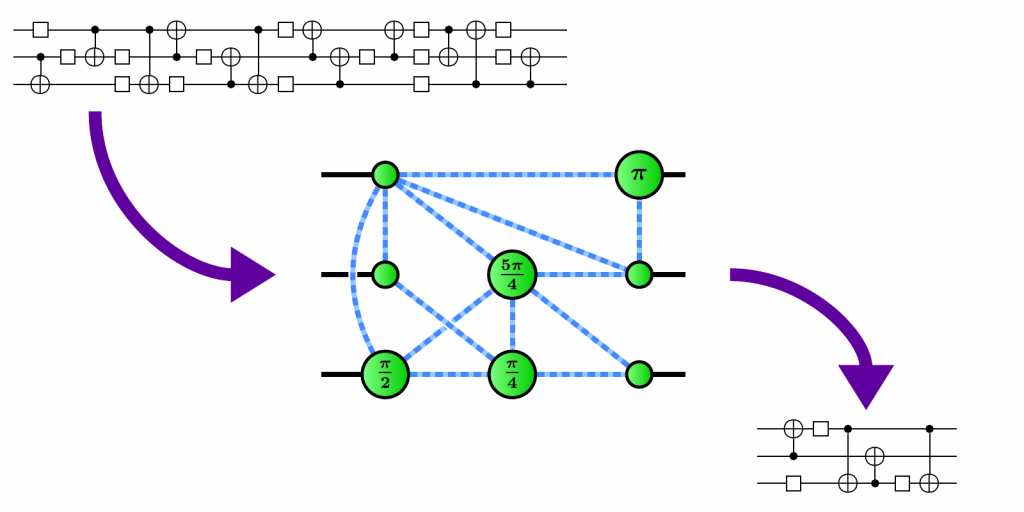 |
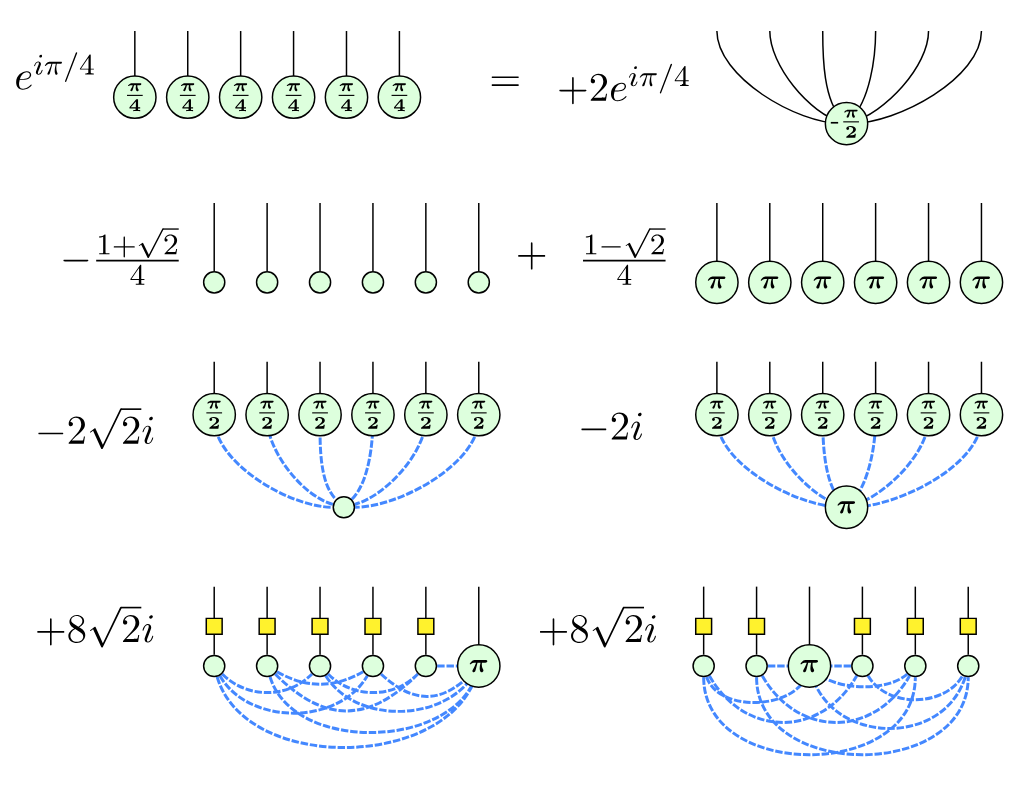 |
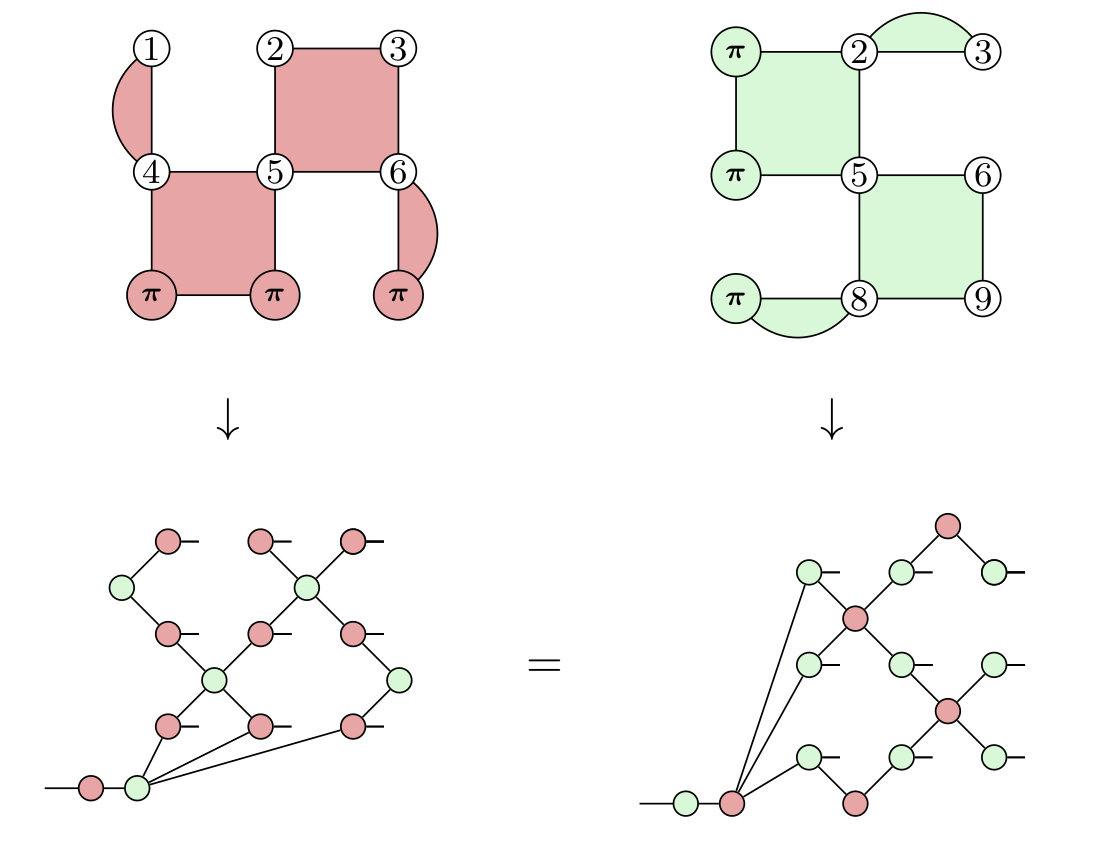 |
| Optimisation | Simulation & Verification | Error Correction |
ZX Diagrams
...give a compact, flexible way to write computations:
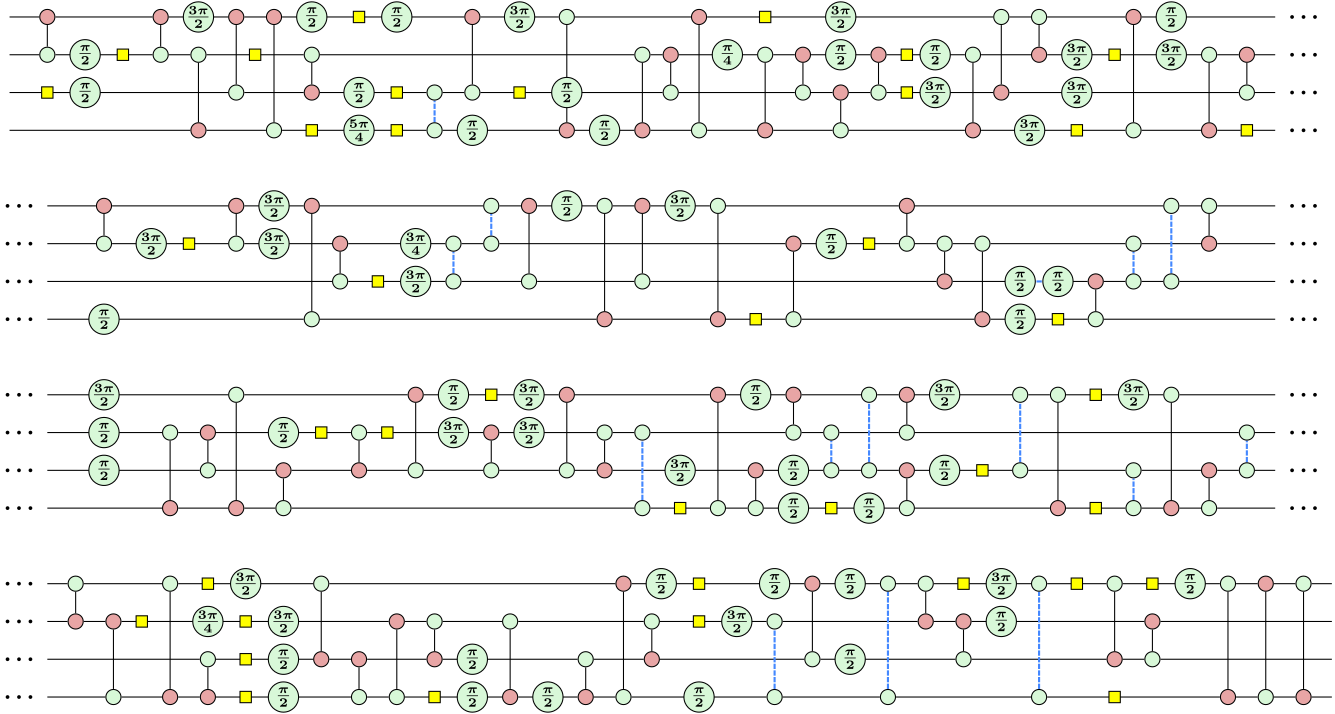 $\Rightarrow$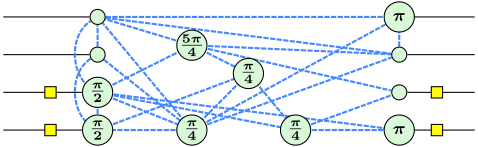
Q: How do you run one?
A1: Circuit extraction

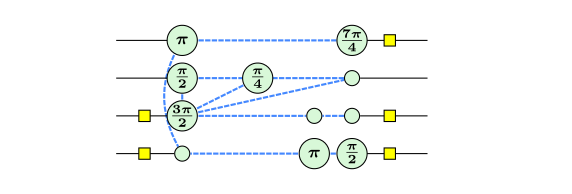
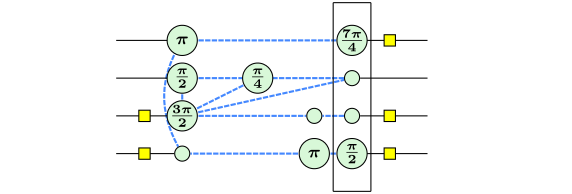
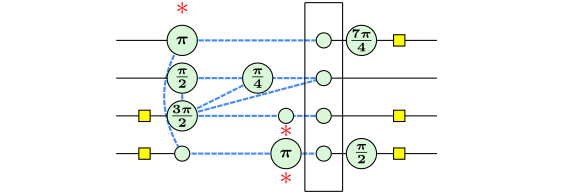
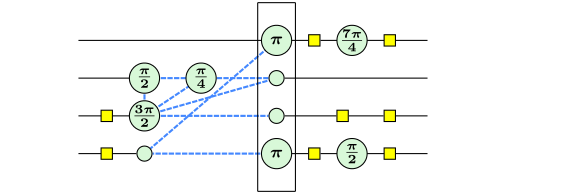
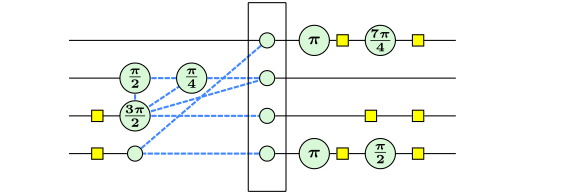
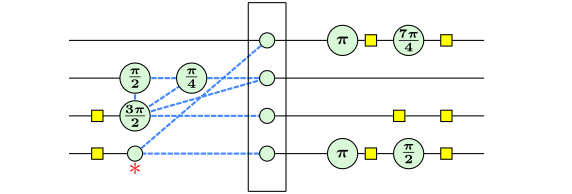
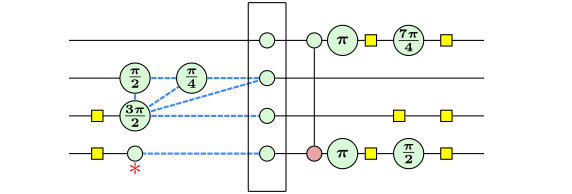
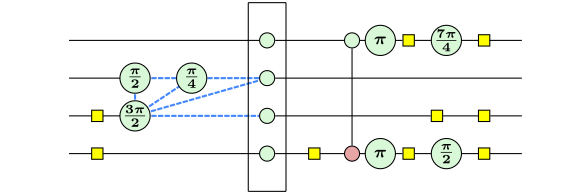
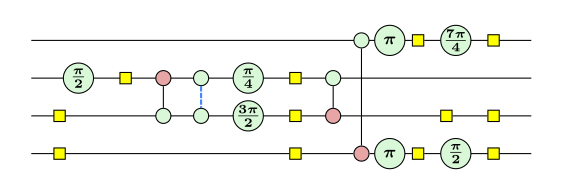
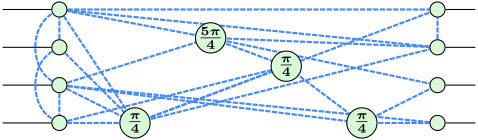
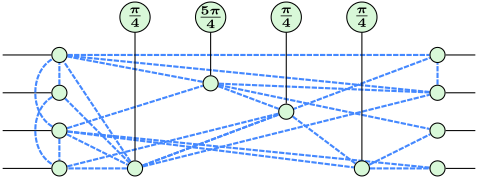
A2: MBQC
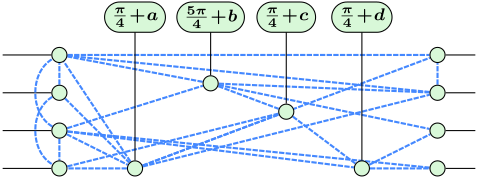
The problem
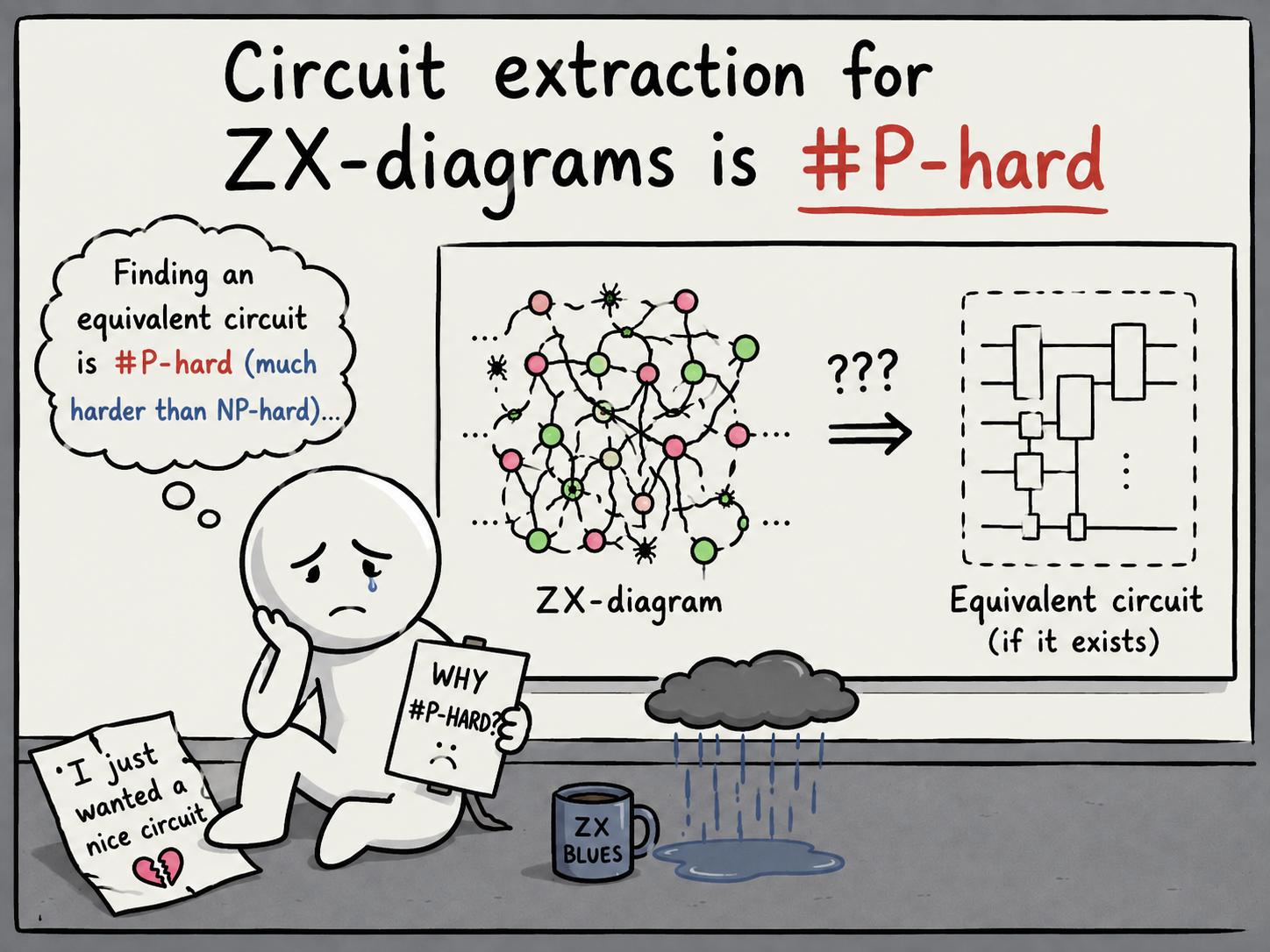
...in fact, it is highly unlikely* that there is any efficient way to "run" a ZX diagram on a quantum computer
* unless QCs can solve NP-complete problems!
Solution
Restrict to ZX-diagrams satisfying some extra sufficient conditions, called flow criteria that make circuit extract efficient.
causal flow → generalised flow → Pauli flow
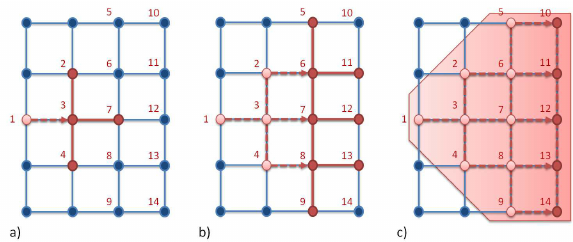
Some issues with flow
Flow criteria are defined for graph states, so ZX diagrams must be kept in graph-like form
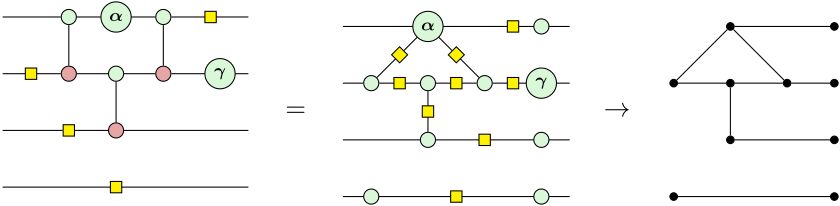
Consequence: all of the basic ZX rules...
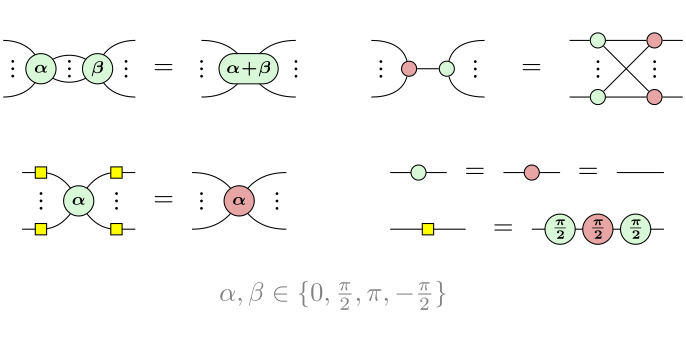
...break flow criteria!
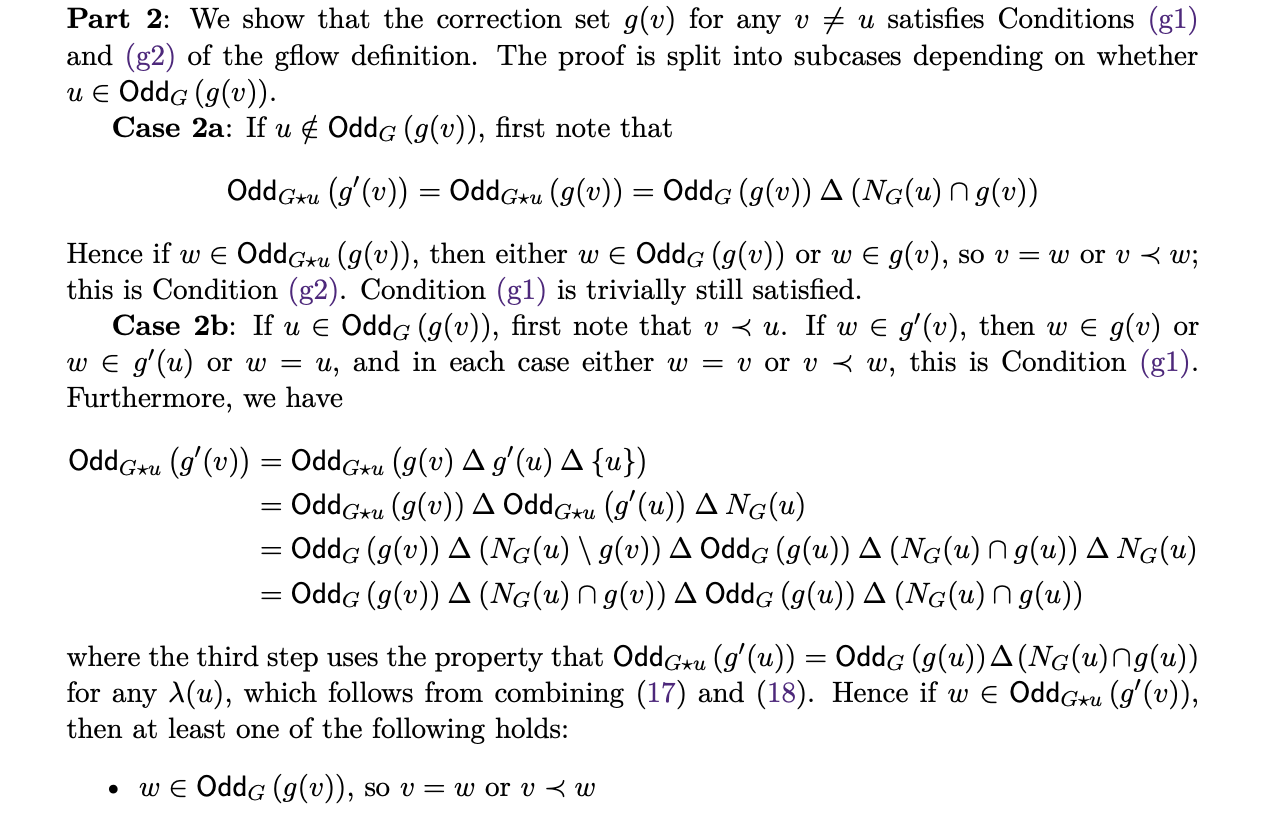
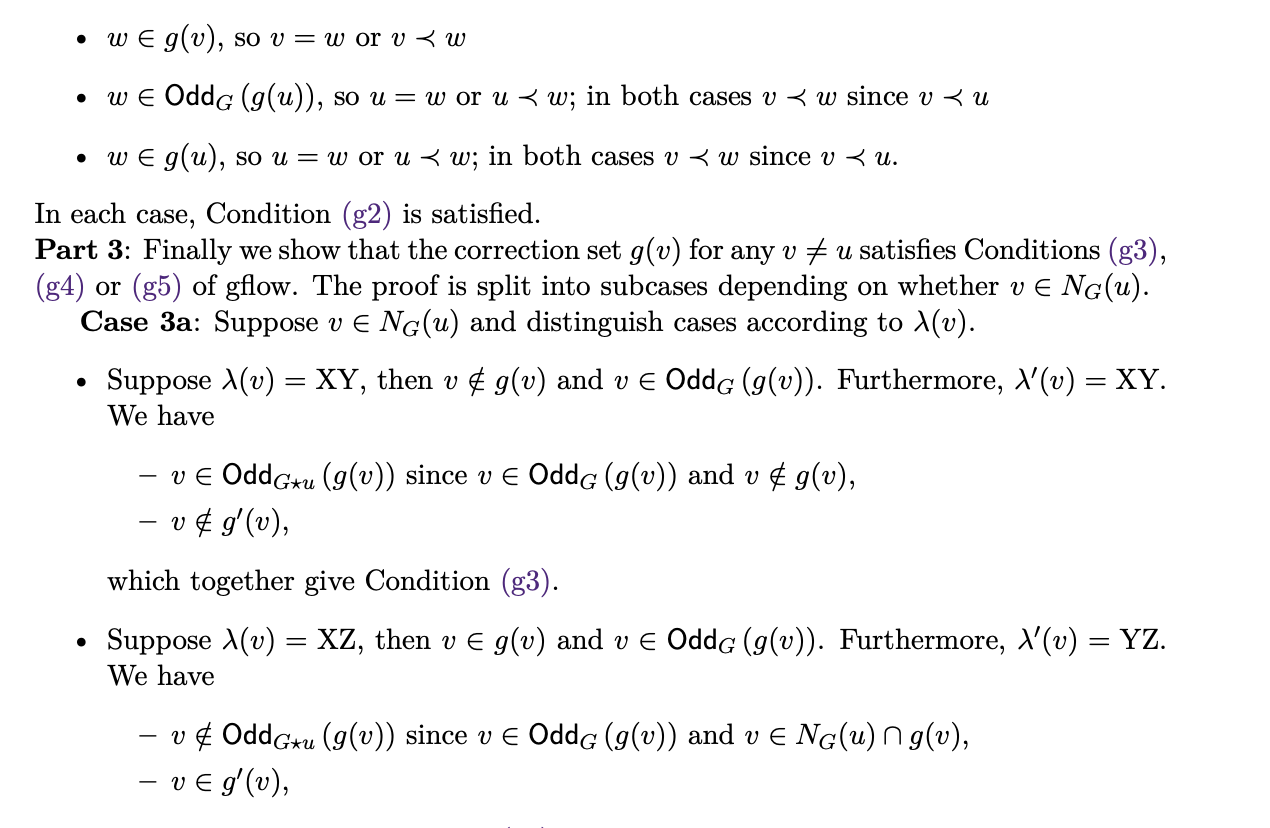
- Derived rules like local complementation preserve flow criteria
- ...but need to be checked 1-by-1, and proofs can get nasty
ZX-flow
A ZX-native flow criterion, based on Pauli semiwebs


- Preserved by all Clifford rewrites, with simple proofs
- $D$ has ZX-flow $\iff$ Clifford-equivalent to $D'$ with Pauli flow
- Intuitive circuit extraction
Pauli webs

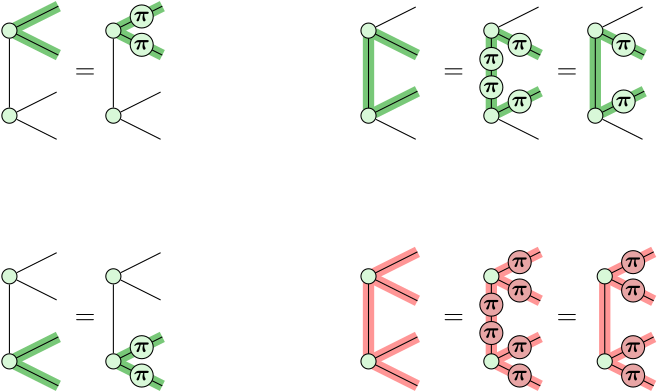
Def: A Pauli string $\vec w \in \mathcal P_{|W|}$ is a Pauli web for a diagram $D$ if every node is an eigenstate for the Pauli operator colouring its neighbourhood
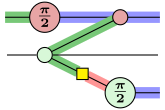 $\Rightarrow$
 $\rangle = -|$$\rangle$
 $\rangle = |$$\rangle$
 $\rangle = |$$\rangle$
 $\rangle = |$$\rangle$
 $\rangle = |$$\rangle$
Pauli webs and stabilisers
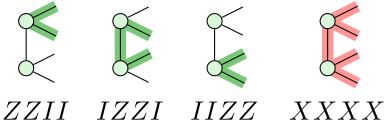
Theorem: A Pauli $\vec P$ stabilises a Clifford ZX-diagram $D$ iff there exists a Pauli web coloring the boundary of $D$ according to $P$.
For states, the Pauli webs give stabiliser generators:
Pauli webs and stabilisers
For Clifford unitaries, Pauli webs give the stabiliser tableau:

Pauli webs and stabilisers
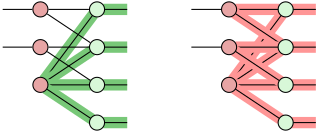
For Clifford isometries, a.k.a. stabiliser codes, Pauli webs give stabilisers + logical operators:

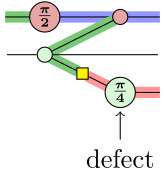
Problem: webs stop at non-Clifford spiders
Idea: generalise to allow local violations web condition, called defects
Pauli semiwebs
Def: A Pauli string $\vec w \in \mathcal P_{|W|}$ is a Pauli semiweb for a diagram $D$ if every node is an eigenstate for the Pauli operator colouring its neighbourhood, up to a phase.
$\Rightarrow$
$\rangle = -|$$\rangle$$\rangle = |$$\rangle$$\rangle = |$$\rangle$$\rangle = |$$\rangle$ $\rangle = \lambda|$
 $\rangle$
ZX-flow
Def: A ZX-flow for diagram $D$ consists of a partial order $\preceq$ on the non-Clifford spiders, plus the following semiwebs:
- for each input $i$: semiwebs $\ell_Z(i)/\ell_X(i)$ that color just the
$i$-th input $Z/X$ and only have defects at non-Clifford spiders
(logical semiwebs) - for each non-Clifford spider $\nu$: a semiweb $f(\nu)$ with a $\pi$-defect at $\nu$ and all other defects at future non-Clifford spiders $\nu' \succeq \nu$
(flow semiwebs)
Example
$($
 $\preceq$
 $)$
$)$
Reading it as MBQC
non-Clifford spider = adaptive single-qubit measurement
wrong outcome? fire $f(\nu)$
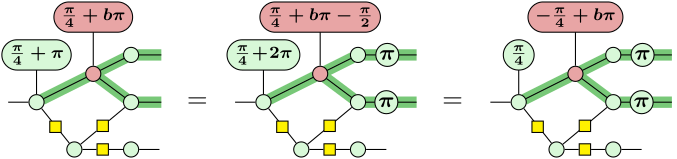
the $\pi$ cancels; future angles get adapted at the defects
Clifford rewrites preserve ZX-flow
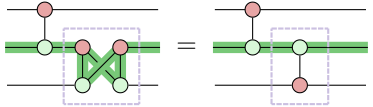
Semiwebs have no defects near Clifford spiders,
so they update locally:
The extended Clifford ZX-calculus
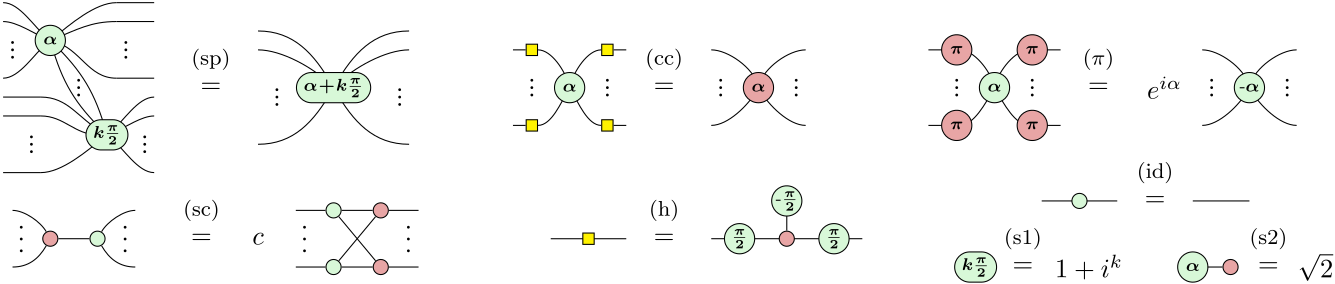
All of these preserve ZX-flow.
Main theorem 1
$D$ has ZX-flow
$\iff$
$D$ is Clifford-equivalent to a graph-like $D'$ with Pauli flow
idea:
- Use preservation of ZX-flow by Clifford rules to reduce to graph-like ZX-diagrams.
- Flow semiwebs in graph-like diagrams cannoically give correction sets for Pauli flow, and vice-versa.
Focusing
Like other kinds of flow criteria, ZX-flow can be focused, which means defects are pushed as far into the future as possible:
$($
$\preceq$
$)$
Focusing
Like other kinds of flow criteria, ZX-flow can be focused, which means defects are pushed as far into the future as possible:

$($
$\preceq$
$)$
Main theorem 2
Let $D$ be a diagram with a focused ZX-flow,
then it can be written as a circuit as follows:
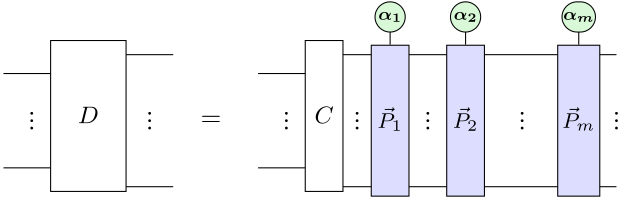
where:
- $\nu_1, \ldots, \nu_k$ ordered according to $\preceq$
- $\alpha_k :=$ the phase of $\nu_k$
- $\vec P_k :=$ restriction of $f(\nu_k)$ to outputs
- $C$ = Clifford isometry with tableau given by $\ell_Z, \ell_X$
Extraction
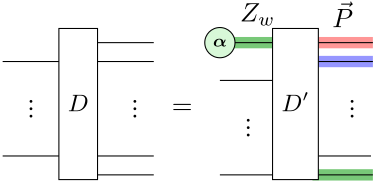
Take $\nu$ maximal, unfuse it, then push it out along $f(\nu)$:
 $\implies$
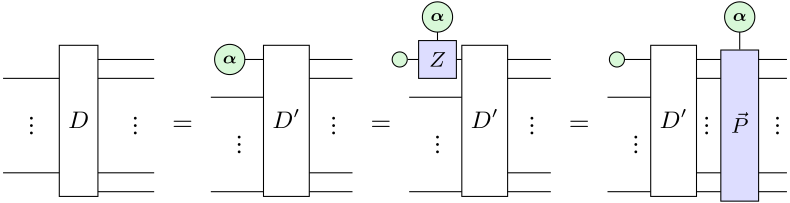
Repeat: strictly fewer non-Clifford spiders each time
Summary
- ZX-flow is a flow criterion made for ZX diagrams
- Simple preservation and extraction arguments
- Paradigm-agnostic notion of "runnability"
- Future work:
- interpretation in other paradigms (lattice surgery, Pauli-based computation, ...)
- $O(n^3)$ ZX-flow finding (Backens/Mitosek style algorithm)
- connection with QEC/fault-tolerance
Thanks!
Paper: arXiv:2603.09580

https://zxcalc.github.io/book (free book!)
https://zxcalculus.com (300+ tagged papers, Discord, online seminar)