Data and Knowledge Group
― Knowledge Representation and Reasoning
KRR People
Yevgeny Kazakov
Research Assistant
Interests
In my research I am interested in applying techniques from automated theorem proving, logic, and complexity theory to knowledge representation and reasoning, and in particular for reasoning in description logics and ontology languages. The topics of my works are quite diverse. I have been working with Hans de Nivelle on the development of resolution-based procedures for various fragments of first-order logic, with Boris Motik on resolution-based procedures for description logics, and with Bernardo Cuenca Grau, Ian Horrocks and Ulrike Sattler on the topic of modularity in ontolgies. Recently, I have been working with Birte Glimm on role conjunctions in expressive description logics, and with Ian Pratt-Hartmann on complexity of graded modal logics. The primary focus of my current work is consequence-based ontology reasoning procedures. I develop a prototype reasoner CB based on such a procedure.
Biography
Currently I am working as a Research Assistant at the Department of Computer Science, University of Oxford and researcher co-investigator for the EPSRC-funded project ConDOR. Previously I was a Research Associate at the University of Manchester funded by the EPSRC project REOL and a PhD student in the Max-Planck-Institut fuer Informatik, Saarbruecken, Germany. I obtained my PhD degree in computer science from the University of Saarland in Germany and my first degree in mathematics from the Moscow State University in Russia.
Publications
My publications can be found herePresentations
The slides from some of my presentations can be found here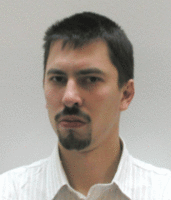
Name
Yevgeny Kazakov
Posts
Research Assistant
Projects
Contact Information
Room 307, Wolfson Building,
Parks Road
Oxford OX1
3QD
Links
News
New Positions!
The KRR group has new postdoctoral positions available! Research topic includes Ontology, Knowledge Graph, Semantic Web, Logics, as well as the interdisciplinary between them and machine learning. Send your CV to Ian or Bernardo. [added on 26/11/2019]
In-Use Track Best Student Paper in ISWC'19>
The paper "Knowledge Graph Embedding for Ecotoxicological Effect Prediction" gets In-Use Track Best Student Paper in ISWC'19. The work was done when the first student author Erik B. Myklebust was visiting the KRR group, with Jiaoyan Chen.
3 Paper accepted in AAAI'18
Three papers co-authored by the KRR group have been accepted in
AAAI'18:
- "Stream Reasoning in Temporal Datalog"
by A. Ronca, M. Kaminski, B. Cuenca Grau, B. Motik, and I. Horrocks;
- "Optimised Maintenance of Datalog Materialisations"
by P. Hu, B. Motik, and I. Horrocks; and
- "Goal-Driven Query Answering for Existential Rules with Equality"
by M. Benedikt, B. Motik, and E. Tsamoura.
Professor Ian Horrocks is a new honorary doctorate at University of Oslo, Faculty of Mathematics and Natural Sciences
Professor Ian Horrocks received an honorary doctorate from the University of Oslo.
Best paper award at IJCAI'17
The paper entitled "Foundations of Declarative Data Analysis Using Limit Datalog Programs" and authored by M. Kaminski, B. Cuenca Grau, B. Motik, E. V. Kostylev, and I. Horrocks received the best paper award at the 26th International Joint Conference on Artificial Intelligence (IJCAI'17).
3 papers accepted in IJCAI'17
Three papers co-authored by the KRR group have been accepted in
IJCAI'17:
- "Query Reformulation: Theory and Practice"
by M. Benedikt, E. V. Kostylev, F. Mogavero, and E. Tsamoura;
- "Foundations of Declarative Data Analysis Using Limit Datalog Programs"
by
M. Kaminski, B. Cuenca Grau, B. Motik, E. V. Kostylev, and I. Horrocks; and
- "The Bag Semantics of Ontology-Based Data Access"
by C. Nikolaou, E. V. Kostylev, G. Konstantinidis, M. Kaminski, B. Cuenca Grau, and I. Horrocks.
Paper accepted in PODS'17
The paper entitled "Benchmarking the chase" authored by Michael Benedikt, George Konstantinidis, Giansalvatore Mecca, Boris Motik, Paolo Papotti, Donatello Santoro, and Efthymia Tsamoura has been accepted in PODS'17.
Andrew Bate defends his PhD Thesis
Andrew Bate has successfully defended his PhD Thesis on Consequence Based Reasoning. Congratulations to Dr. Andrew Bate!
Best applications paper award at ISWC'16
Our paper entitled "Semantic Technologies for Data Analysis in Health Care" received the Best Applications Paper Award at the International Semantic Web Conference (ISWC 2016).
4 papers accepted in ISWC'16
Four papers authored by the KRR group have been accepted in the International Semantic Web Conference (ISWC 2016).
Best paper award at ICDT'16
Mark Kaminski and Egor Kostylev received the best paper award at ICDT 2016 for their paper entitled "Beyond Well-Designed SPARQL".